2nd November 2022
IC Armenia suggests new regulations for remote and hybrid work in Armenia
Labor Code
Sub-Council
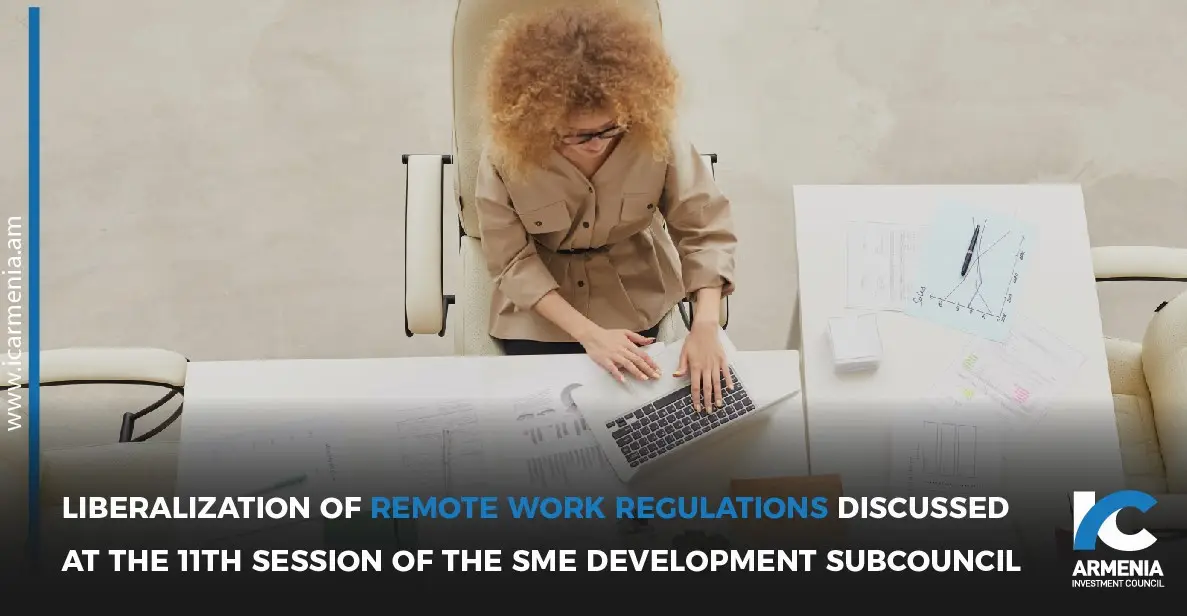
During the 11th session of the SME Development Council held in October, a number of issues aimed at protecting the interests of the business community and ensuring uninterrupted and smooth business activities were discussed at the initiative of the experts of the Investment Council of Armenia, as well as the members of the SME Development Council. The meeting was chaired by RA Deputy Minister of Economy Rafayel Gevorgyan.
Among agenda items was the issue of regulation of remote and hybrid work in the Labor Code of RA. Nowadays, many employers and employees use remote work approach, taking advantage of modern technological possibilities. However, widely used remote and hybrid work formats are not sufficiently reflected in the labor code regulations, which causes problems for employers.
The proposed package of regulations supposes regulating some key aspects and features of the employer-employee relationship typical of remote and hybrid work, guided by the most liberal approaches (for example, defining who is considered a remote employee for the company, defining that the employer and the hired employee are free to choose the most suitable work format for them, at the same time being free to modify it by mutual agreement, etc.).
Along with the proposed solutions, the team of the Investment Council of Armenia also presented drafts of legislative amendments, which will be circulated among relevant departments and will be processed after receiving feedback.
Updates on further developments will be available in the news section of the council's website.
The Investment Council of Armenia serves as a public-private dialogue platform between the Government of Armenia and SME Associations targeted at the development of business-oriented legislative reforms and operates through monthly sub-council meetings led by the Minister of Economy, quarterly council meetings led by the Deputy Prime Minister of Armenia. Throughout 15 years of operation, 25 large-scale legislative reforms have been passed through the Investment Council of Armenia, including the preferential tax regime for IT start-ups, the introduction of a sales tax regime, leasing reforms, and many more.